Premade Cabinets: Sizes, Styles and Lead Times
A first cabinet purchase usually starts with a photograph and ends with a tape measure. CasaBuilt sells standard sizes only — base cabinets from 9 to 42 inches wide, wall cabinets from 9 to 39 inches, three wall heights and two standard depths — and the basic six-cabinet kitchen is listed from $1,184.93 in Hudson Grey to $2,295.64 in Slim White Oak. Understanding that grid is what turns a style decision into an order.
Key takeaways
- Base cabinets are 34-1/2 inches high and 24 inches deep, in twelve widths from 9 to 42 inches.
- Wall cabinets are 12 inches deep, in heights of 30, 36 and 42 inches, with widths from 9 to 39 inches.
- The site lists 28 cabinet items across four construction groups: Shaker 11, Framed 14, Frameless 2 and Raised Panel 1.
- RTA orders ship in 3-10 business days; assembled orders are quoted at within two weeks.
What is fixed before you choose a style
Premade cabinetry is not a compromise on quality so much as a compromise on geometry. The widths are set by the factory, the heights are set by the factory, and the only thing the buyer controls is which combination of those boxes fits the room. That is why the measurement comes first and the door style comes second, even though the showroom instinct is to do it the other way round.
For a first-time buyer, the fixed grid is useful. It removes the paralysis of infinite choice and replaces it with a puzzle that has a countable number of solutions. The wall is a length. The cabinets are a list of widths. The gap that remains is a filler or a slightly different cabinet, and CasaBuilt's measurement guide walks through the readings the plan depends on: wall length, ceiling height, window and door positions, and appliance widths.
The size grid, read as a shopping list
Base cabinets come in twelve widths: 9, 12, 15, 18, 21, 24, 27, 30, 33, 36, 39 and 42 inches. Every one of them is 34-1/2 inches high and 24 inches deep, which means a run of mixed widths still lines up at the counter. Vanity cabinets share the height but drop to 21 inches deep, and they run from 12 to 48 inches wide, with a 36-inch knee drawer listed at 7 inches high.
Wall cabinets are 12 inches deep and come in three heights: 30, 36 and 42 inches. Widths run from 9 to 39 inches. The height choice changes the kitchen more than any other single decision, because a 42-inch wall cabinet leaves far less wall between the counter and the cabinet than a 30-inch one. Bridge and refrigerator cabinets fill the space above appliances, and they are listed at 12, 15, 18 or 24 inches high, 12 or 24 inches deep, and 24 to 36 inches wide.
Tall cabinets are where the grid gets specific. The oven cabinet listing is 33 inches wide, 84 inches high and 24 inches deep, and the code SWOO338424 carries all three dimensions in the name. That level of specificity is normal for a premade range and it is the reason a buyer should write the cabinet code on the plan rather than the description. Two cabinets described as "tall oven cabinet" can differ by six inches of width.
How many styles are actually offered
The catalogue sorts premade cabinets by construction rather than by color, and the group counts are small enough to work through in an evening. The table below shows what each group contains. The totals matter because a first-time buyer often assumes the range is either one style in many colors or many styles in one construction; here it is neither.
| Group | Items listed | Door profile | What it describes |
|---|---|---|---|
| Shaker | 11 | Shaker, Double Shaker, Slim Shaker | A recessed center panel with a visible frame, in painted and wood-look finishes |
| Framed | 14 | Raised panel and framed profiles | Cabinets built around a face frame, which is the traditional construction |
| Frameless | 2 | Full-access slab and slim profiles | No face frame, so the door covers more of the opening |
| Raised Panel | 1 | Raised panel | A single traditional profile held as its own listing |
Named styles inside those groups include White Shaker, Hudson Grey Shaker, Navy Blue Shaker, Slim White Oak, Slim Aston Green Shaker, Smokey Ash Shaker, Charleston White Double Shaker, Espresso Shaker, Iron Black Shaker, High Gloss Gray and several more. The color range is broad for a direct seller: five whites, three grays, two browns, one black, one beige, one green and one navy across the sample library. A buyer who wants a specific green or navy should confirm it against a physical sample rather than a screen, because paint reads differently at 8 a.m. and 8 p.m.
Lead times, and what they depend on
Timing divides by format. Flat-packed cabinetry is listed at 3-10 business days to dispatch; assembled cabinetry is quoted at within two weeks, and Alaska and Hawaii sit outside the standard window. Buyers in the trade program can also ask about its quick-ship commitment of three business days or less, which is a program benefit rather than the default.
The gap between the two formats is the assembly step. RTA cabinets arrive flat-packed with hardware and instructions; assembled cabinets arrive closed and ready to hang. For a first-time buyer the choice is usually about confidence rather than time: assembly is a few hours per cabinet for someone who is comfortable with a screwdriver, and a genuine obstacle for someone who is not. Ordering the assembled line buys back those hours at the cost of a longer ship window.
Sequence the order around the trades rather than the calendar. Countertops are templated after the base cabinets are set, appliances arrive on their own schedule, and flooring usually goes in before the cabinets on a full remodel. A cabinet order that lands a week before the countertop template is a cabinet order that is on time.
Worked example: two price tiers
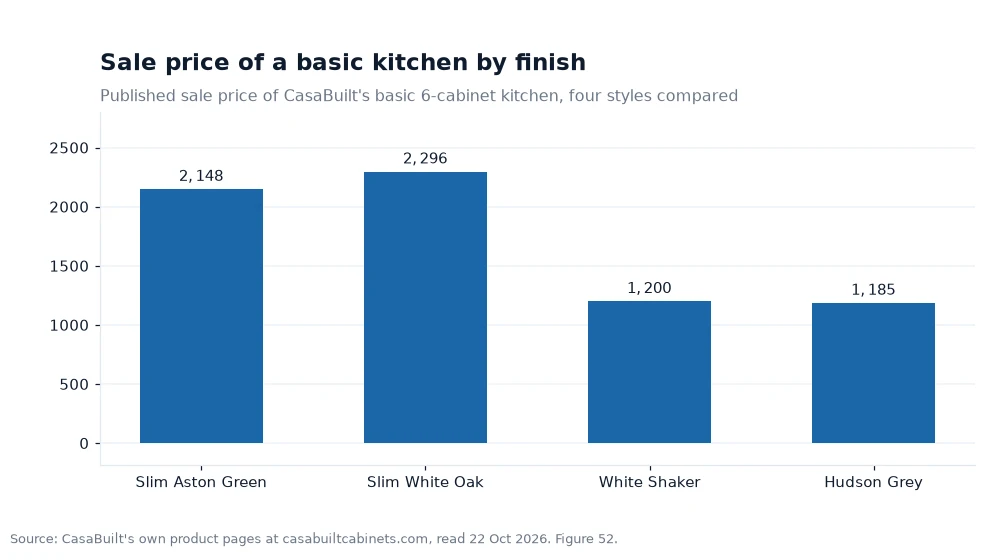
The chart compares four finishes at the bundle level: Slim Aston Green $2,148.28, Slim White Oak $2,295.64, White Shaker $1,199.50 and Hudson Grey $1,184.93. The two painted Shaker lines sit within $14.57 of each other: $1,199.50 minus $1,184.93 equals $14.57. The two slim lines sit $147.36 apart: $2,295.64 minus $2,148.28 equals $147.36.
Between the tiers the gap is much wider. Subtract $1,184.93 from $2,295.64 and the difference is $1,110.71 for the same six cabinets. As a ratio, $2,295.64 divided by $1,184.93 is 1.94, so the Slim White Oak bundle costs 94% more than the Hudson Grey bundle. Averaging each pair makes the two tiers explicit: the painted pair averages $1,192.22 and the slim pair averages $2,221.96, a difference of $1,029.74 between one cabinet tier and the next.
One more comparison is worth doing before the order. The Slim White Oak bundle at $2,295.64 is $88.79 less than buying both painted bundles together: $1,199.50 plus $1,184.93 equals $2,384.43. Nobody needs twelve cabinets for a six-cabinet kitchen, but the arithmetic shows how much of the price sits in the finish rather than in the count of boxes.
Frequently asked questions
Can I change a standard cabinet's width?
No. The widths are published as a fixed list — 9 to 42 inches for bases, 9 to 39 inches for walls — and the plan is built from those options. The gap that remains at the end of a run is closed with a filler or a panel rather than a custom width, which is why the wall measurement should be taken at more than one height.
Which wall cabinet height should a first-time buyer choose?
It depends on the ceiling and on how much working wall you want above the counter. A 30-inch cabinet leaves the most space, a 36-inch is the common middle, and a 42-inch raises the storage and reduces the gap. All three are 12 inches deep, so the choice does not change the footprint on the floor plan.
Are assembled cabinets worth the longer lead time?
Assembled orders are quoted at within two weeks, against 3-10 business days for RTA. The assembled line removes the build step and any risk of an assembly error, so it suits buyers who are not confident with flat-pack instructions or who are paying a fitter by the hour. The RTA line suits buyers who want the shortest window.
Measure, then choose, then order
Take the wall lengths at counter height and at cabinet height, note every window and outlet, and write down the appliance widths before opening the style pages. Then shortlist two finishes and order samples, because the difference between a $1,184.93 bundle and a $2,295.64 one is visible in daylight and invisible on a screen. The size grid decides whether the kitchen fits; the finish decides what it costs.
Figures quoted here come from the manufacturer's own website, read 22 Oct 2026[1.